Blackseal Waterproofing: A Proven Below-Ground Solution for Auckland Homes
When it comes to protecting Auckland homes from our notoriously wet climate, choosing the right waterproofing membrane can mean the difference between a dry, healthy basement and years of costly moisture problems. At A Plus Waterproofing, one of the products we frequently specify for below-ground work is Sika BlackSeal — a liquid-applied, bitumen-based waterproofing system that has earned its reputation across New Zealand for reliability, compliance, and ease of application. In this post, we break down what Blackseal is, where it excels, and why it continues to be a trusted choice for Auckland retaining walls, basements, and foundations.
What Is Sika BlackSeal?
Sika BlackSeal is a family of liquid-applied bitumen waterproofing membranes manufactured by Sika NZ, formulated specifically for below-ground applications. The two most commonly used variants in the New Zealand market are BlackSeal Elastic and BlackSeal Plus (NZ). Both are water-based bitumen emulsions, which means they are low-odour, solvent-free, and can be cleaned up with water — a significant advantage on residential sites where occupants are often in close proximity to the work.
BlackSeal Elastic is a flexible, polymer-modified bitumen emulsion engineered to prevent water vapour transmission through walls and underground structures. BlackSeal Plus (NZ) is a similar bitumen-based emulsion formulated specifically as a waterproof membrane behind retaining walls and as a damp-proof membrane for the buried faces of basement structures.
Where Blackseal Is Used
Blackseal is purpose-built for below-ground and concealed applications. Typical uses include:
-
Damp-proofing membrane behind retaining walls
-
Damp-proofing for underground basement structures and buried wall faces
-
Masonry block walls complying with NZS 4229 and NZS 4210
-
Precast and in-situ concrete walls designed under NZS 3101
-
Sealing over concrete, concrete block, brickwork, wood and (in the Plus variant) metal substrates
It is important to note that Blackseal is not a UV-stable or trafficable topcoat — it is designed to be buried, backfilled, or covered by a protection sheet. For exposed decks, roofs or tiled wet areas, different membranes (such as TPO, Viking Peel & Stick, or Ardex WPM300) should be specified instead.
Why Blackseal Performs So Well in Auckland Conditions
Auckland’s combination of clay soils, heavy seasonal rainfall, and sloping sites places enormous hydrostatic and vapour pressure on below-ground walls. Blackseal is formulated to handle exactly these conditions.
Vapour Flow Resistance
BlackSeal Elastic has been BRANZ-tested to a mean vapour flow resistance of not less than 90 MNs/g, comfortably exceeding the vapour barrier requirements set out in E2/AS1 – Table 23. BlackSeal Plus (NZ) likewise meets the moisture vapour permeability requirements of NZS 3604:2011 and exceeds the vapour flow resistance level for a water vapour barrier in E2/AS1. This means moisture in the soil behind the wall is stopped from migrating through the concrete into habitable interior spaces — a key factor in preventing musty smells, mould growth, and damage to interior linings.
BRANZ Appraised and Code-Compliant
BlackSeal Elastic carries BRANZ Appraisal No. 770 (2023) as a damp-proof membrane and is recognised for compliance with New Zealand Building Code clauses B2 (Durability), E2 (External Moisture), and F2 (Hazardous Building Materials). It was also approved by Auckland Council in 2012 for NZBC compliance, giving councils, builders and homeowners confidence during consent and inspection processes.
Chemical and Ground Resistance
Auckland’s clay and volcanic soils can contain sulphates and ground salts that attack inferior membranes over time. Both BlackSeal Elastic and BlackSeal Plus (NZ) are resistant to sulphates and ground salts, which is critical for the long-term durability of any retaining or basement wall.
Application Advantages
One of the reasons A Plus Waterproofing regularly turns to Blackseal on residential projects is how practical it is on site.
-
Water-based and solvent-free, so clean-up is done with water and fumes are minimal
-
Fast cure — BlackSeal Elastic can be re-coated after approximately four hours, weather dependent
-
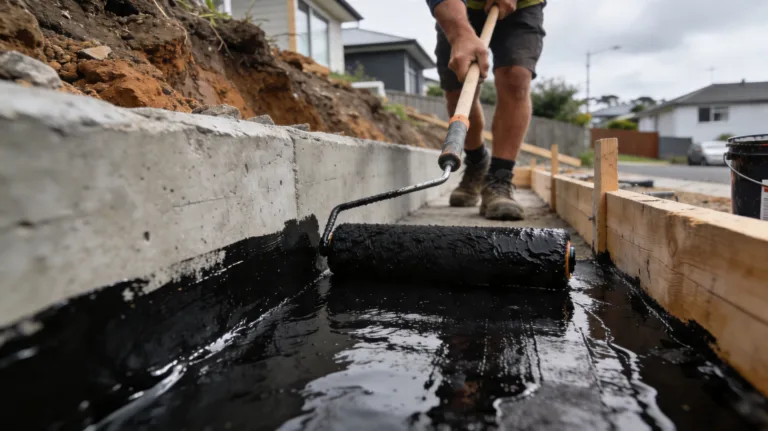
Applies by brush, roller or spray, giving flexibility on tight or awkward retaining walls
-
Can be applied to green concrete, which shortens programme times when working around newly poured retaining walls or basement slabs
-
Easily repaired if damaged prior to backfilling
Typical Application Process
For BlackSeal Elastic, the specified process is a diluted primer coat (one part product to one part clean potable water) applied at around 4 m² per litre, followed by two undiluted top coats at 2 m² per litre each. The first top coat is laid off horizontally and, once cured, a second coat is applied vertically to ensure full film build and eliminate pinholes. The membrane is then protected with a Sika BlackSeal Protection Sheet held in place with dabs of Sika BlackSeal-1 sealant before backfill is reinstated.
BlackSeal Plus (NZ) follows a similar two-coat regime at a minimum total application rate of 1 litre per m² over the primer. As with any liquid-applied bitumen system, it must be protected immediately after curing using a suitable protection sheet to prevent backfill damage.
Substrate Preparation — Where Most Failures Happen
No membrane performs well over a dirty, damp, or uneven substrate, and Blackseal is no exception. Before application, the substrate should be clean, sound, and free of laitance, dust, curing compounds and contaminants. Irregularities and honeycombing should be filled using Sika MonoTop repair mortars or Sikadur-41 epoxy repair mortar, and the surface should be lightly dampened — but with no standing free water — before priming. Control joints and cracks require dedicated treatment with BlackSeal-1 sealant, which is formulated specifically for sealing cracks, holes and connection joints in bitumen systems.
Skipping these preparation steps is one of the most common reasons waterproofing fails in Auckland homes, and it is why we always insist on a thorough site assessment before any product hits the wall.
Who Should Install Blackseal?
BlackSeal Elastic meets NZ Building Code requirements when applied by a Licensed Building Practitioner (LBP) who has completed Sika’s online training and registered with Sika NZ Ltd. This matters for two reasons: it protects the homeowner’s warranty, and it gives councils confidence during PS3 producer statement sign-off. A Plus Waterproofing is Auckland Council PS3 and LBP certified, and our team installs Sika systems to the manufacturer’s specification so that the appraisal and warranty remain valid.
Blackseal Elastic vs Blackseal Plus (NZ) at a Glance
| Feature | BlackSeal Elastic | BlackSeal Plus (NZ) |
|---|
| Feature | BlackSeal Elastic | BlackSeal Plus (NZ) |
|---|---|---|
| Type | Flexible polymer-modified bitumen emulsion | Bitumen-based emulsion |
| Primary use | Damp-proofing behind retaining walls and underground structures | Waterproof membrane behind retaining walls and buried basement faces |
| BRANZ status | Appraisal No. 770 (2023) | BRANZ tested, exceeds E2/AS1 vapour requirements |
| Code compliance | B2, E2, F2 — Auckland Council approved | Meets NZS 3604:2011 vapour permeability |
| Green concrete | Yes | Yes |
| Application | Brush, roller; two undiluted coats over primer | Brush, roller or spray; two coats over primer |
| Protection | Requires Sika BlackSeal Protection Sheet | Requires protection sheet before backfill |
When Blackseal Is the Right Call
Blackseal is an excellent choice when the wall is going to be buried or permanently concealed, when a robust vapour and damp-proof barrier is required behind a retaining structure, and when the project needs a BRANZ-appraised, council-recognised system installed by an LBP. It is cost-effective, fast to apply, and proven over decades of use on New Zealand basements and retaining walls.
It is not the right product for exposed decks, balconies, tiled showers, or roofs — those need purpose-designed membranes with UV stability, trafficability, or tile-adhesion compatibility, all of which Blackseal does not provide.
Get a Free Auckland Site Assessment
If you are building a new basement, extending a retaining wall, or dealing with a damp below-ground wall in an older Auckland home, Blackseal may be the right solution — but it is only as good as the preparation and installation behind it. A Plus Waterproofing offers free site visits across Auckland, provides detailed written quotes, and installs Sika BlackSeal systems to full manufacturer specification so your home stays dry for the long haul.