Retaining Wall Waterproofing: What Every Auckland Homeowner Needs to Know
Retaining walls are a defining feature of Auckland’s hilly, sculpted landscape. From tiered gardens in Titirangi to split-level driveways on the North Shore, these structures hold back tonnes of earth every single day. But here’s what many homeowners don’t realise until it’s too late: a retaining wall without proper waterproofing is a liability waiting to become a very costly repair.
At A Plus Waterproofing, we’ve seen firsthand what happens when waterproofing is ignored or done poorly. This guide covers why retaining wall waterproofing matters, the warning signs to look out for, the best systems available in New Zealand, and what a professional installation process actually looks like.
Why Auckland’s Climate Makes Waterproofing Non-Negotiable
Auckland receives around 1,200mm of rainfall annually, and that’s before accounting for the intense downpours the region increasingly experiences. Add in our clay-heavy soils — which are notoriously poor at draining water — and you have the ideal conditions for hydrostatic pressure to build up behind any retaining wall.
Hydrostatic pressure is the force exerted by trapped water against a structure. As saturated soil accumulates water with nowhere to go, that pressure pushes relentlessly against the back face of your retaining wall. Without a quality waterproofing system in place, it’s only a matter of time before something gives way.
The consequences are both costly and progressive:
-
Cracking and bulging in the wall structure
-
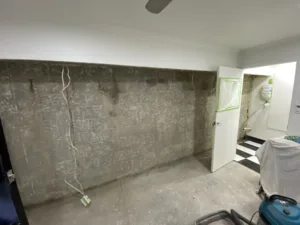
Efflorescence — white chalky mineral deposits on the wall face, signalling water seepage
-
Mould and persistent damp affecting adjacent living spaces or garages
-
Soil erosion and subsidence undermining the wall’s foundation
-
Council compliance failures and loss of property value
In short, retaining wall waterproofing isn’t an optional upgrade — it’s a foundational requirement for any wall in contact with retained soil.
Warning Signs Your Retaining Wall Has a Waterproofing Problem
Catching problems early can save you thousands. Watch for these indicators:
-
White mineral streaks on the wall face (efflorescence)
-
Damp patches or water staining on the internal side of the wall
-
A musty smell near the base of the wall or in an adjacent basement
-
Wall movement or leaning — a sign of sustained pressure
-
Pooling water at the base of the wall after rain
-
Cracks running vertically or diagonally through concrete or masonry
If you notice any of these signs, a professional assessment is warranted. Early intervention is far more cost-effective than structural repairs.
How Retaining Wall Waterproofing Works
Effective retaining wall waterproofing is a multi-layer system — not just a coating. The goal is to create a seamless barrier that prevents water from penetrating the wall while also managing and redirecting water that accumulates behind it. There are three key components:
1. Surface Preparation
No membrane performs well on a compromised substrate. Before any product is applied, the wall surface must be thoroughly cleaned, cracks filled, voids repaired, and the surface profiled for proper adhesion. Skipping this step is one of the most common reasons waterproofing fails prematurely.
2. Primary Waterproofing Membrane
This is the heart of the system — the impermeable barrier applied directly to the back face of the wall. The choice of membrane depends on the wall type, soil conditions, and project scope. Products used in New Zealand include:
-
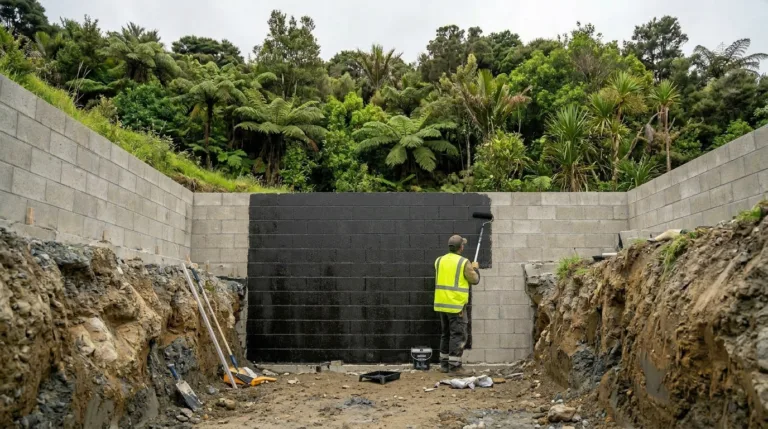
Sika Blackseal — a bitumen-based brush-applied coating, excellent for rough concrete and blockwork surfaces. It delivers a seamless barrier resistant to aggressive soils and is NZ Building Code certified for below-ground applications.
-
Bituthene 3000 — a self-adhesive, cold-applied membrane with self-healing properties. It conforms to uneven surfaces, resists maximum hydrostatic pressure, and is BRANZ-appraised and widely used across Auckland builds. Proven durability of 50+ years when correctly installed.
-
Viking Torch-On Membrane — a heat-welded, multi-layer bituminous system offering commercial-grade protection. Seams are fully welded for zero weak points, making it the system of choice on larger or more demanding projects.
-
Nuralite Nuraply — a torch-on membrane with 30+ years of proven performance in New Zealand, offering root and chemical resistance — ideal for garden retaining walls or areas near landscaping.
3. Drainage Layer and Membrane Protection
A waterproofing membrane alone is not enough. Once backfilling begins, unmanaged drainage can still allow hydrostatic pressure to build up and can physically damage the freshly applied membrane.
A drainage and protection board — such as Nuralite Nuradrain — is installed over the membrane before backfilling. This serves two critical functions:
-
It channels water downward and away from the wall, significantly reducing hydrostatic pressure.
-
It protects the membrane from mechanical damage during the backfilling process.
A perforated drain pipe at the base of the wall, discharging to a suitable stormwater outlet, completes the drainage system.
Torch-On vs. Brush-Applied: Choosing the Right System
Not all retaining walls need the same solution. Here’s a quick guide to help you understand the key differences:
| System | Application Method | Best Use Case | Durability |
|---|---|---|---|
| Torch-On (Viking / Nuralite) | Heat-welded, multi-layer | Large walls, new builds, high-risk sites | 30–50+ years |
| Self-Adhesive (Bituthene 3000) | Cold-applied, peel & stick | Complex shapes, detailed surfaces, retrofits | 50+ years |
| Brush-Applied (Sika Blackseal) | Brush coat | Blockwork, rough surfaces, repairs, retrofits | 30+ years |
For existing walls that are beginning to leak, brush-applied and self-adhesive systems can often be installed with minimal disturbance — a significant advantage when excavation is difficult or costly.
NZ Building Code and Council Compliance
Retaining wall waterproofing in New Zealand is governed by NZ Building Code Clause E2 (External Moisture). The code requires that walls in contact with or close to retained soil prevent moisture absorption that could cause dampness or structural damage. In particular, a tanking membrane — not merely a damp-proof membrane — is typically required for concrete masonry retaining walls.
When waterproofing work requires a building consent, a Producer Statement (PS3) may be required from the licensed waterproofing installer to confirm the work has been completed in accordance with the design and code requirements. At A Plus Waterproofing, all our work is backed by full documentation to support your council compliance obligations.
The A Plus Waterproofing Waterproofing Process
Every retaining wall project is different. Our process is methodical, fully documented, and tailored to your specific site:
-
Site Assessment — We assess the wall’s construction material, condition, soil type, drainage situation, and risk profile.
-
Surface Preparation — All cracks, voids, and surface imperfections are repaired to ensure maximum membrane adhesion.
-
Joint Detailing — Additional reinforcing membrane strips are applied to joints, corners, and penetrations — the areas most vulnerable to leaks.
-
Primary Membrane Application — We select and apply the most appropriate system: Sika Blackseal, Bituthene, or Viking/Nuralite torch-on.
-
Drainage and Protection Layer — Nuradrain or equivalent drainage board is installed before backfilling.
-
Final Inspection and Documentation — Quality control check followed by council-ready paperwork and workmanship warranty.
Is It Worth Waterproofing an Existing Retaining Wall?
Absolutely. Many homeowners assume that waterproofing can only be done during construction — but that’s not the case. With modern systems like Bituthene and Sika Blackseal, existing walls can often be waterproofed through partial excavation or even from the positive (wet) side depending on the situation.
The cost of proactive waterproofing is a fraction of what you’ll spend on structural repairs, mould remediation, or dealing with a retaining wall that has shifted or failed. Beyond the structural savings, a professionally waterproofed wall increases your property’s value and reduces the risk of costly insurance disputes.
Talk to the Experts at A Plus Waterproofing
Retaining wall waterproofing is not a DIY job. It requires the right products, proper surface preparation, and the expertise to select and apply the correct system for your specific wall and soil conditions. Getting it wrong means doing it twice — at considerable expense.
A Plus Waterproofing specialises in retaining wall and basement waterproofing across Auckland. We are LBP certified, use only NZ Building Code-compliant products, and back all work with a written workmanship warranty.
If your retaining wall is showing signs of moisture, or if you’re planning a new build and want it done right from the start, get in touch with the team at A Plus Waterproofing for a professional site assessment. Because in Auckland’s climate, waterproofing isn’t something you can afford to leave to chance.